Description
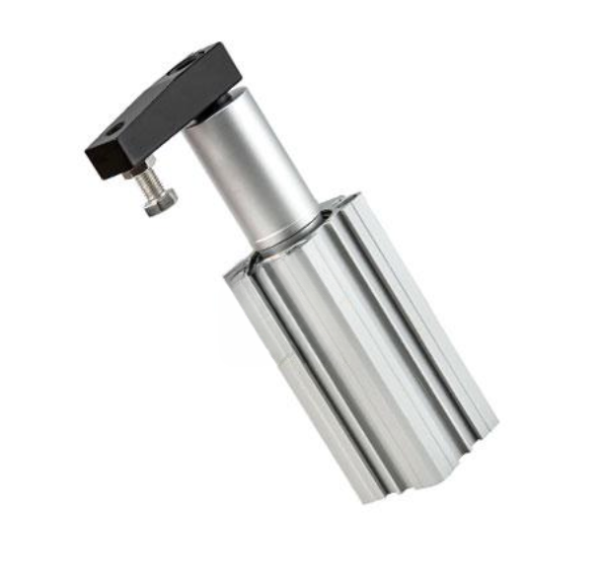
A clamp jack is a type of pneumatic jack that allows for the automation of the manual clamping operation of standard toggle clamps, opening up new applications. They are actuated by compressed air and can be used to securely clamp parts remotely at the push of a button. If the pressure is released, the pneumatic clamp remains closed. Pneumatic clamps, which are used to move the clamping arm out of dead center, facilitate the absorption of the main holding force.What are some general safety tips to know when using clamps?
Wear safety glasses or goggles, or a face shield (with glasses or goggles). Select the appropriate clamp style and size by matching the job holding needs to the characteristics of the clamp. Consider strength and weight (e.g., consider the rail size and rated clamp pressure), reach (reach length), and throat depth (reach depth).
Check ease of adjustment, clamp surfaces (materials used and dimensions, make sure the knob at the end of the screw turns easily before use. Discard clamps with bent frames; replace bent spindles if possible. Make sure the pressure plate and anvil parts of the clamp are in full contact with the workpiece before tightening. Close the jaws until the clamp feels secure. For example, some of the adhesive will come out when clamping, which is an indication that the clamp is tight enough. Use C-clamp pads to prevent marking on the work.
Remove the clamps as soon as you are finished. The clamps only serve as temporary devices to hold the work in place. Lightly oil all moving parts of the clamps and keep the tools clean to prevent slipping. Also, make sure there is no dirt or oil on any part that comes into contact with the work. Store C-clamps by placing them on a shelf, not in a drawer.
Choosing a Clamping Jack
– Don’t use oversized clamps just because of their large throats. Instead, use deep clamps.
– Don’t use any clamps that have a curved frame or curved spindle.
– Don’t use wrenches, pipes, hammers, or pliers to tighten clamps. Only use wrenches on clamps designed for wrenches.
– Don’t use C-clamps for moving or pulling. Use special lifting clamps.
– Don’t use C-clamps to build scaffolding or platforms for workers.
Types of Clamping Jacks
Pneumatic clamps are generally known for being activated using compressed air. This reduces the strain on the user, especially in cases where repeated clamping operations are performed. Pneugostar offers a wide range of clamping jacks.
Standard pneumatic clamp: In comparison to manual clamps, pneumatic clamps can be activated simultaneously and can also be closed in a specific sequence. In addition, single or multiple clamps can be controlled from different points. They can be controlled manually or automatically. Based on the principle of the key lever system, the clamping jack remains closed even in the event of an air failure. In addition, air consumption is low due to the high final transmission ratio. Other advantages of the key lever system include the large opening movement achieved by rotating the clamp arm and the optimized force-movement ratio.
Pneumatic Push-Pull Clamps: Pneumatic clamps in push-pull style can be used as both push and pull clamps. The robust design and FESTO double-acting pneumatic cylinder ensure a long service life for the clamp.
Pneumatic Rotary Clamps: Rotary clamps can be used to hold certain workpieces in jacks, plates and workbenches. The rotary function is designed to ensure that the clamping points are free for placing and removing workpieces, thus ensuring an optimal workflow. The housing block design offers universal clamping possibilities and allows for optimal alignment of the rotary clamp with the clamped workpiece.
Small clamps: As their name suggests, small clamps are known for their small dimensions and light weight. They are mainly used for economical production. Their application areas include conveyor lines, machine tools, equipment and special machines. Small clamps allow for precise positioning of the clamp arm and are fully self-locking, thus preventing the clamp from opening due to machining forces. The key lever clamp ensures that high clamping forces are achieved even with low air pressure and air consumption. Small clamps are maintenance-free as they are equipped with permanent lubrication and special bearing bushings.




Reviews
There are no reviews yet.